Your digging level
Description
Murga uruguaya is a choral-theatrical music of Uruguay’s Montevideo Carnival, performed by a large chorus with a small percussion battery. It blends satire, social commentary, and humor with distinctive close-harmony vocals and driving march-like rhythms.
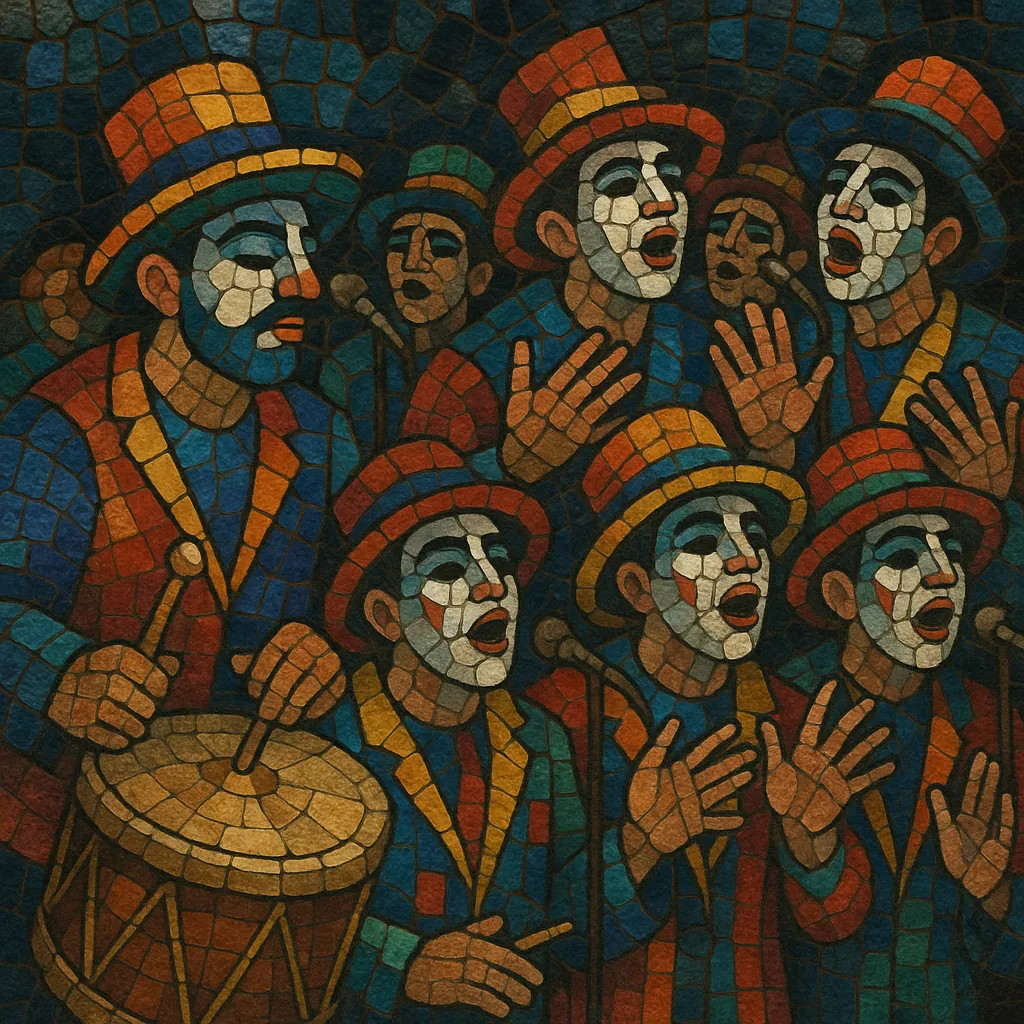
A typical troupe features 13–17 singers arranged in high, middle, and low voices, led by a director, and accompanied by the classic three-piece battery: bombo con platillo (bass drum with attached cymbal), redoblante (snare), and platillos (hand cymbals or cymbal accents). Performances are staged with colorful costumes and face paint, and follow a dramatic arc through set numbers such as saludo (greeting), presentaciones, cuplés (satirical songs), popurrí, and the emotive retirada (farewell).
History
Murga uruguaya crystallized in Montevideo around the turn of the 20th century, drawing on local carnival practices and touring Iberian carnival troupes. It absorbed Spanish carnival theater traditions while grounding its sound in Afro-Uruguayan rhythmic culture (especially the street-drumming legacy of candombe). By the 1900s–1910s, the format of a costumed chorus with a compact percussion battery was established.
During the interwar decades, murga solidified key traits: the three-piece battery (bombo con platillo, redoblante, platillos), dense close-harmony choruses led by a director, and a dramaturgical sequence of numbers (saludo, cuplés, popurrí, retirada). Its musical language favored bright, march-like 2/4 grooves (the "marcha camión") and tuneful, often triadic choral writing, while lyrics developed the genre’s hallmark satirical, topical edge.
In the context of political turbulence and censorship, murga remained a vehicle for coded critique and social reflection. Troupes honed double entendre, allegory, and humor to comment on daily life and politics, strengthening murga’s identity as a popular chronicle of the city and its people.
From the 1990s onward, professionalization, recordings, and international touring broadened murga’s reach. New generations refreshed arrangements, theatrical direction, and vocal textures, and collaborations with rock and popular music scenes elevated murga’s profile beyond Carnival stages. Today it remains a living tradition—competitive and community-based—whose retirada and cuplés continue to capture the year’s sentiments with wit and choral power.