Your digging level
Description
Liwa (Līwa) is a traditional Khaleeji music-and-dance form of African origin that took root across Eastern Arabia—especially Oman, the United Arab Emirates, Bahrain, Qatar, Kuwait, and the Eastern Province of Saudi Arabia—and also in coastal southern Iran and among the Sheedi and Baloch communities of the Makran Coast and Karachi.
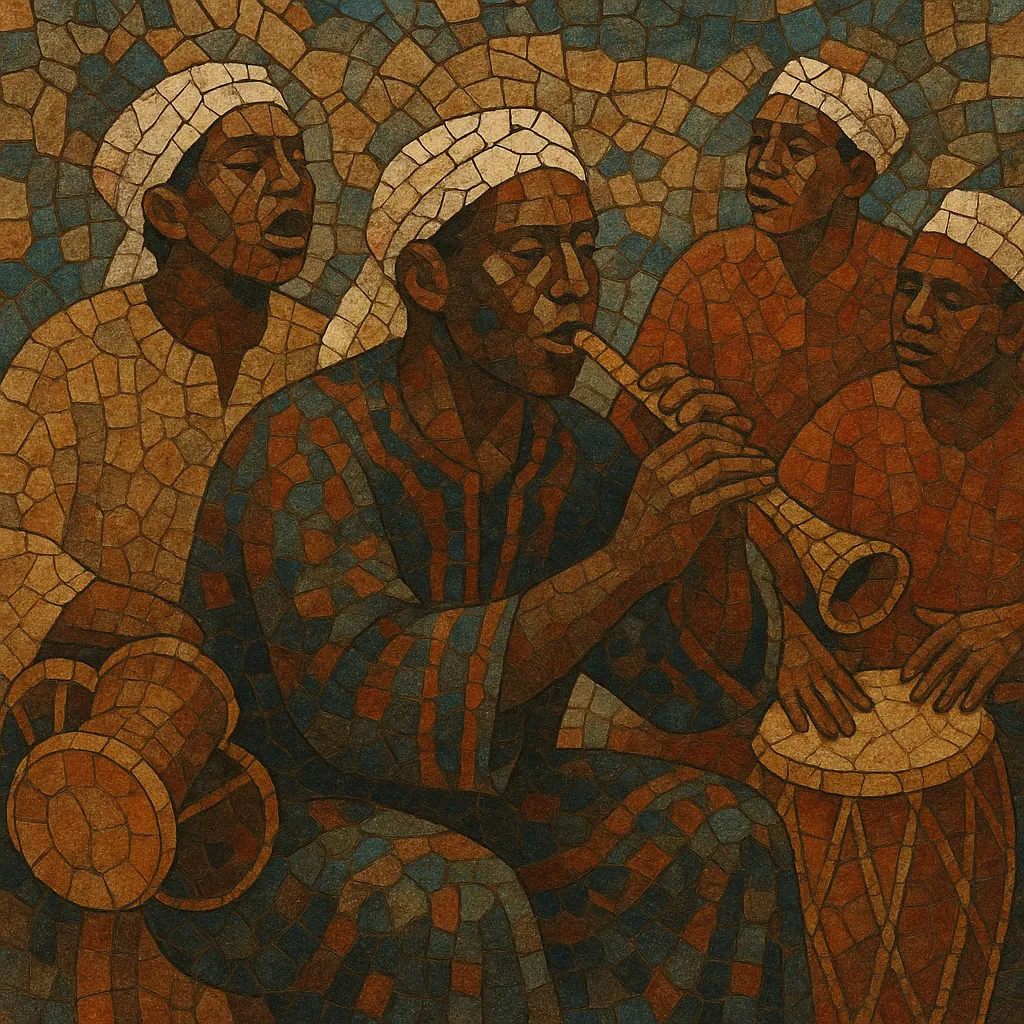
It is typically performed in a circle or short procession, with call-and-response singing led by a double-reed mizmar (zurna-type) and a battery of Gulf and East African–derived drums. Lyrics and refrains often alternate between Khaliji Arabic and Swahili, reflecting the genre’s Swahili Coast roots and its Gulf home.
Musically, Liwa is marked by a fast compound 6/8 or driving 2/4 feel, interlocking drum patterns, and a piercing mizmar that cues dancers and singers. The style is festive and social—heard at weddings, community celebrations, and seafaring/pearl-diving commemorations—yet it also carries the memory of African–Arabian exchanges and diasporic histories.
History
Liwa most likely crystallized in the 19th century amid intense maritime links between Oman (and the wider Gulf) and East Africa—especially Zanzibar and the broader Swahili Coast. Afro–Arab exchanges, including trade and migration, brought Swahili musical aesthetics, instruments, and performance practices to the Arabian shores.
As coastal Gulf towns grew, Liwa became embedded in local community life. It was adopted and adapted by Omani and Emirati coastal communities, by Baharna in Bahrain and Qatif, by Baloch groups along the Makran coast (in Iran and Pakistan), and by the Sheedi community in Karachi. In Hormozgan (southern Iran), Liwa performance sits alongside bandari traditions, sharing rhythms, instruments, and dance vocabularies.
The classic Liwa ensemble centers on the mizmar (a conical double-reed) plus a family of drums (large barrel/bass drums and smaller frame or goblet drums). Performance is communal: singers and dancers form a circle; a lead voice initiates phrases answered by the chorus. Texts often switch between Khaliji Arabic and Swahili, testifying to the genre’s transoceanic roots.
Today Liwa is presented at national festivals (e.g., in the UAE and Oman), weddings, and community events, and by heritage troupes. While some groups preserve older patterns, others integrate Liwa rhythms, chants, and mizmar lines into contemporary Khaleeji popular music, keeping the Afro–Arab dialogue audible in the Gulf soundscape.

%2C%20Cover%20art.webp)