Your digging level
Description
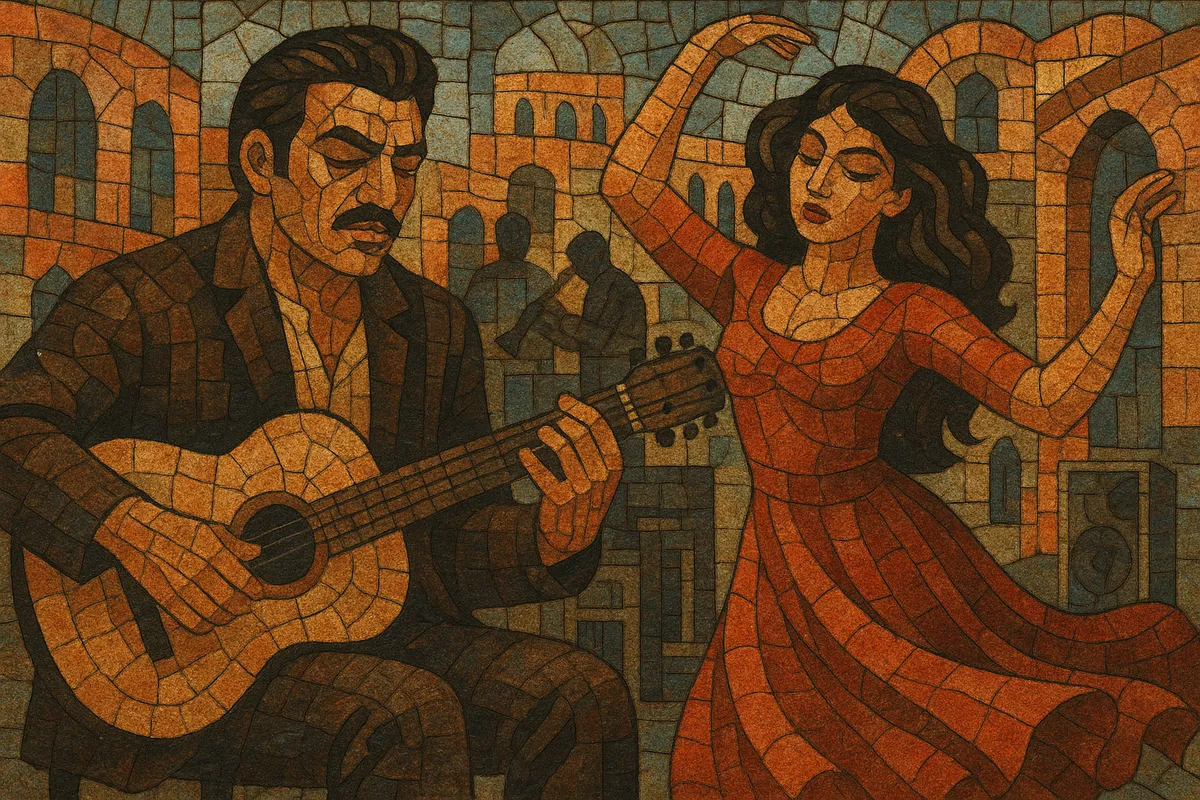
Koche Bazari (Koocheh-Bazari, literally “street/market style”) is a popular, working‑class branch of Persian music that blends traditional Iranian melodic vocabulary with lively, dance‑forward rhythms.
Built around the ubiquitous 6/8 (shesh‑o‑hasht) groove, it borrows phrasing and ornamentation from Persian classical/dastgāh practice while embracing accessible song forms, catchy refrains, and colloquial lyrics. Its sound often includes violin or clarinet over a band with electric guitar/organ, bass, drum set, and hand percussion (tombak, dayereh, darbuka), yielding an immediately festive timbre.
Humorous, socially observant, and sometimes rough‑and‑tumble in tone, Koche Bazari absorbed influences from neighboring Arabic and Turkish popular styles (including Arabesque and belly‑dance idioms) yet stayed unmistakably Iranian in modal flavor and vocal delivery.
History
Post‑war urbanization in Iran swelled Tehran’s working‑class districts, coffeehouses, and cabarets. Musicians active in these spaces fashioned a street‑savvy repertoire that married dastgāh‑rooted melodies to upbeat 6/8 grooves and colloquial storytelling. This environment fostered what came to be called Koche Bazari—music of the alleyways and bazaars, designed for dancing and communal singing.
Through the 60s and 70s the style flourished in cafés, neighborhood concerts, and film soundtracks. Amplified bands added organ, electric guitar, and drum kit to violin/clarinet and hand percussion, while singers cultivated a charismatic, “jaheli” (tough‑guy) persona. The repertoire mixed love songs, comic vignettes, and snapshots of city life. Cross‑border listening—Arabic pop, Turkish Arabesque, and Greek laïkó—reinforced its rhythmic drive and ornamental vocabulary.
Following the 1979 Revolution, public dance‑pop performance in Iran was curtailed. Koche Bazari activity shifted toward private gatherings and the diaspora (especially Los Angeles), where its 6/8 pulse and sing‑along refrains continued in studio productions, sometimes modernized with synths and drum machines.
While often labeled “street” or “mass” music, Koche Bazari proved foundational for Iranian pop at large: its grooves, hooks, and vernacular delivery persist in contemporary dance‑pop and even color elements of Iranian rap’s streetwise stance. Revival interest and archival reissues have reframed the style as a vital urban folk‑pop that mapped everyday life with humor, heart, and undeniable swing.