Your digging level

For this genre
0/8
🏆
Sign in, then listen to this genre to level up

Description

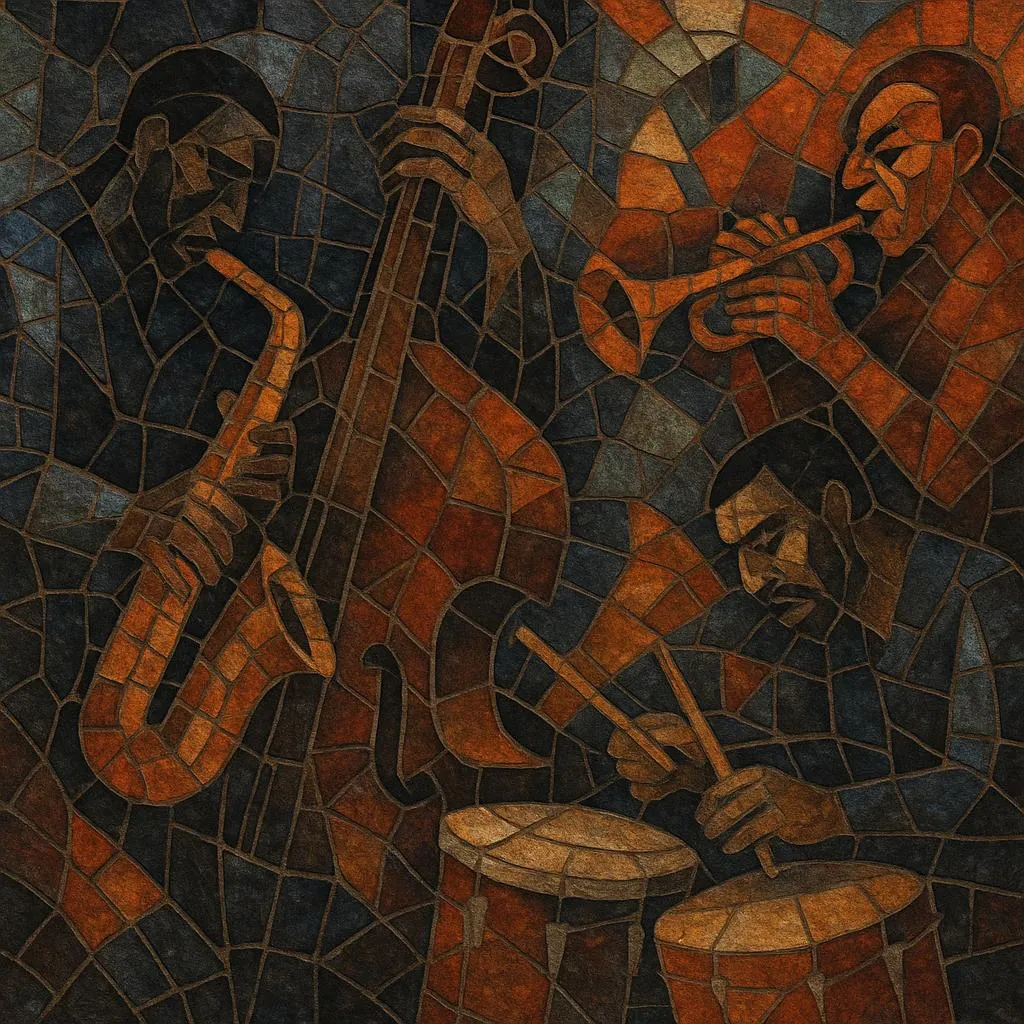
Deep free jazz is a particularly exploratory, long‑form, and intensity‑seeking branch of free jazz that prizes collective improvisation, timbral risk‑taking, and spiritual/emotive depth.

Compared to more head‑solo‑head jazz formats, it deemphasizes fixed harmony and meter in favor of open forms, evolving textures, and interaction as the compositional motor. Players often use extended techniques (multiphonics, overblowing, prepared piano, arco noise, unconventional percussion) and stretch pacing from whisper‑quiet stasis to cathartic climaxes.

While rooted in the U.S. “new thing” of the 1960s, deep free jazz also absorbed modal spaciousness, spiritual/ritual energies, and (especially in Europe) the aesthetics of free improvisation and contemporary classical, resulting in music that can be fierce, meditative, or both within a single performance.


Sources: Spotify, Wikipedia, Discogs, RYM, MB, user feedback and other online sources

History

Origins (1960s)

Deep free jazz grew from the U.S. “new thing,” where musicians pushed past bebop and post‑bop harmony into open forms and collective improvisation. Modal thinking (fewer chord changes, longer harmonic fields) provided breathing room, while the civil‑rights era’s urgency encouraged raw expression and boundary‑breaking.

Expansion and Globalization (late 1960s–1970s)

As scenes flourished in New York, Chicago, and elsewhere, the music also took root in Europe, where state‑supported venues, labels, and festivals encouraged experimental work. European players blended the American free‑jazz vocabulary with free improvisation and contemporary classical timbres, yielding an even broader color palette and an emphasis on texture and form over chordal motion.

Aesthetic Traits Consolidate (1970s–1980s)

Hallmarks became clear: long arcs; extremes of dynamics; extended techniques; non‑metered or polymetric drumming; bass moving between pulse and texture; horns favoring cries, multiphonics, and speech‑like phrasing; and ensembles treating composition as a set of cues and territories rather than fixed chord progressions.

Continuities and Revivals (1990s–present)

Independent labels, archives, and festivals sustained the music, while a new generation of improvisers folded in influences from spiritual jazz, free improvisation, and electroacoustic practice. Today, deep free jazz remains a living practice—valued for its communicative intensity, spiritual searching, and refusal of stylistic ceilings.

How to make a track in this genre

Ensemble and Instrumentation
•   Typical small groups: saxophones/clarinets, trumpet, piano, double bass, drum set; often expanded with flutes, bass clarinet, auxiliary percussion, or electronics. •   Encourage doubling and color changes (e.g., soprano/tenor sax, prepared or inside‑piano techniques, bowing the cymbals, extended arco on bass).
Form and Structure
•   Replace head–solo–head with open forms: brief thematic cells, interval motives, or textural cues that can recur, mutate, or vanish. •   Use cueing: hand signals or eye contact to trigger density changes, duos/trios within the group, or sudden stops.
Rhythm and Pulse
•   Alternate between free time, elastic swing, and polymetric fragments. Drums can steer density and contour rather than keep constant time. •   Bass may move between grounded ostinati, pedal tones, and noise/timbral roles (e.g., bow squeals, harmonics, col legno).
Harmony and Melody
•   Favor modal centers or no fixed harmony; think intervallically (e.g., minor 2nds/major 3rds cells) or timbrally (tone color as harmony). •   Explore extended techniques: horn multiphonics, overblowing, alt fingerings; piano clusters and strings; microtonal bends.
Interaction and Narrative
•   Treat composition as social improvisation: listen, answer, provoke, leave space. •   Shape macro‑forms (quiet beginnings → turbulent middle → emptied aftermath) and dynamic arcs to create an overall narrative without chord charts.
Practical Process
•   Workshop short motifs and conduction cues in rehearsal; record long live takes to capture emergent form. •   Balance contrast: silences vs. torrents, brittle timbres vs. warm overtones, solo spotlights vs. collective eruptions.

Top tracks

Locked
Share your favorite track to unlock other users’ top tracks

Upcoming concerts

in this genre
Influenced by
Has influenced

Download our mobile app

Get the Melodigging app and start digging for new genres on the go
© 2026 Melodigging
Melodding was created as a tribute to Every Noise at Once, which inspired us to help curious minds keep digging into music's ever-evolving genres.
Buy me a coffee for Melodigging