Your digging level
Description
Cuatro music is a family of Latin American traditions built around the cuatro, a small fretted lute whose name derives from its four original strings. While all cuatros trace back to Iberian plucked‐string instruments of the colonial era, regional variants developed distinctive constructions and playing styles—most famously the four‑string, re‑entrant‑tuned Venezuelan cuatro and the ten‑string, five‑course Puerto Rican cuatro.
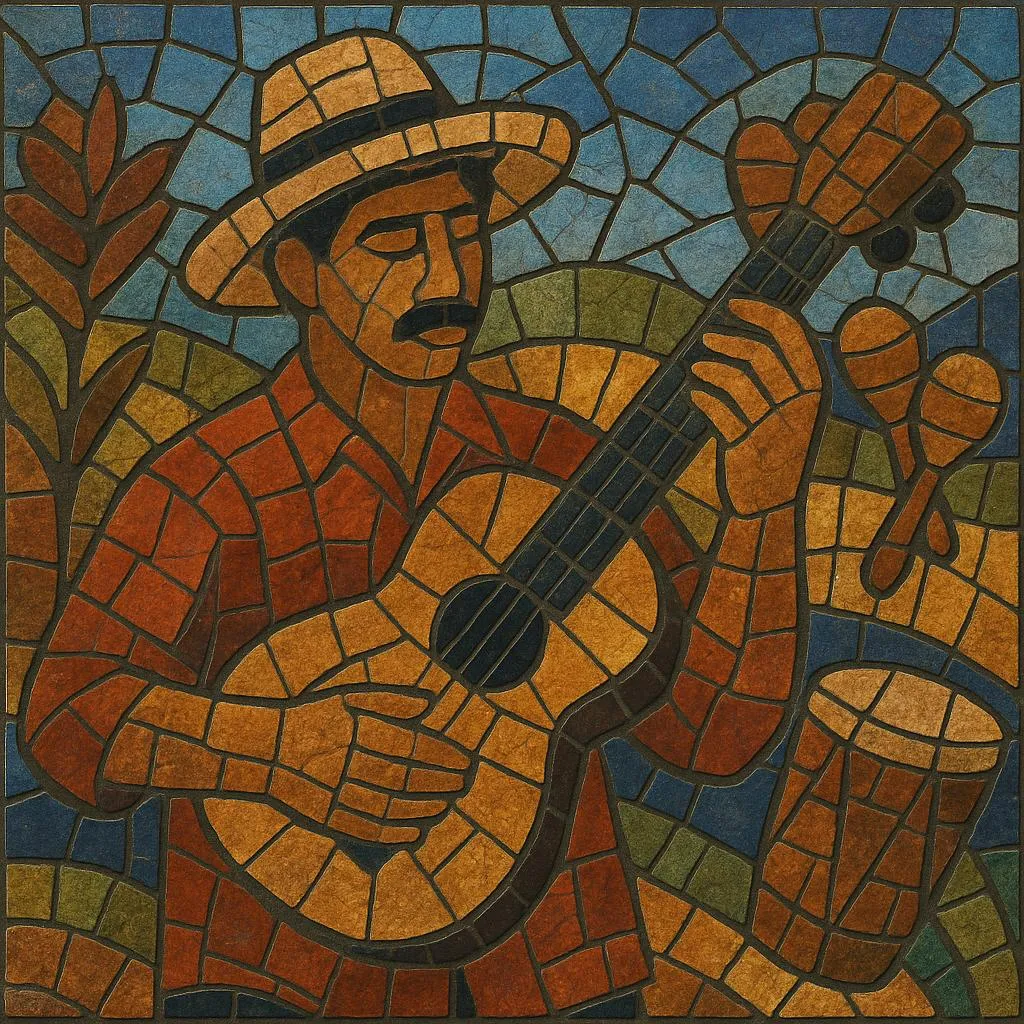
As a result, "cuatro music" is not one single repertoire but a constellation of styles in which the cuatro is the lead harmonic–rhythmic engine: Venezuelan joropo and gaita zuliana; Puerto Rican jíbaro genres such as seis and aguinaldo; Colombian/Eastern Llanos repertoires; and Caribbean parang, among others. Across these scenes, the instrument provides propulsive strums, syncopated "golpes" (percussive strokes), fast arpeggios, and bright chord voicings that interlock with maracas, hand percussion, and dance‑driven meters. The sound is agile, ringing, and rhythmic—equally at home accompanying sung décimas and festive parranda gatherings or featured as a virtuosic solo instrument.
History
Cuatro music emerges from the transplant of Iberian plucked strings (baroque guitar, bandola/bandurria family) to the Caribbean and northern South America during the colonial era. By the late 18th and 19th centuries, creole communities adapted these instruments into locally built cuatros, adopting re‑entrant tunings and compact bodies that suited dance accompaniment and portable, outdoor performance.
Radio and record industries of the 20th century spread cuatro idioms beyond rural contexts. In Puerto Rico, the cuatro entered concert halls and popular ensembles; in Venezuela, virtuosos codified advanced right‑hand patterns, turning the instrument into a solo voice. Migration and pan‑Caribbean exchanges brought the cuatro into salsa, nueva canción, and Latin jazz settings.
Today, cuatro music thrives in festivals, conservatories, and cross‑genre collaborations. Luthiers refine both traditional and modern designs; pedagogues publish graded methods; and contemporary cuatristas tour globally, expanding technique (percussive taps, harmonic cascades, extended chords) while honoring dance‑floor roots in joropo, jíbaro, and parang.
Lead: A cuatro variant appropriate to the tradition you are writing in.
•Venezuelan cuatro: 4 nylon strings, re‑entrant tuning (commonly A–D–F#–B), bright and percussive.
•Puerto Rican cuatro: 10 steel strings in five courses tuned in fourths; chorus‑like shimmer and strong melodic projection.
•Rhythm section (as needed): maracas (Venezuela/llanos), bass or quinto, arpa llanera or bandola (joropo); güiro/panderos (Puerto Rico); hand percussion for parang.