Your digging level
Description
Crimean Tatar music is the traditional and popular music of the Crimean Tatars, a Turkic people indigenous to the Crimean Peninsula on the Black Sea.
It blends Turkic-Ottoman makam (modal) practice with Black Sea dance rhythms and Slavic-Caucasian timbral influences, resulting in a repertoire that moves fluidly between free-rhythm laments and driving asymmetric dances.
Signature pieces such as the haytarma dance highlight characteristic aksak (limping) meters like 9/8 and 7/8, while vocal styles favor microtonal inflections, melisma, and heterophonic ensemble textures.
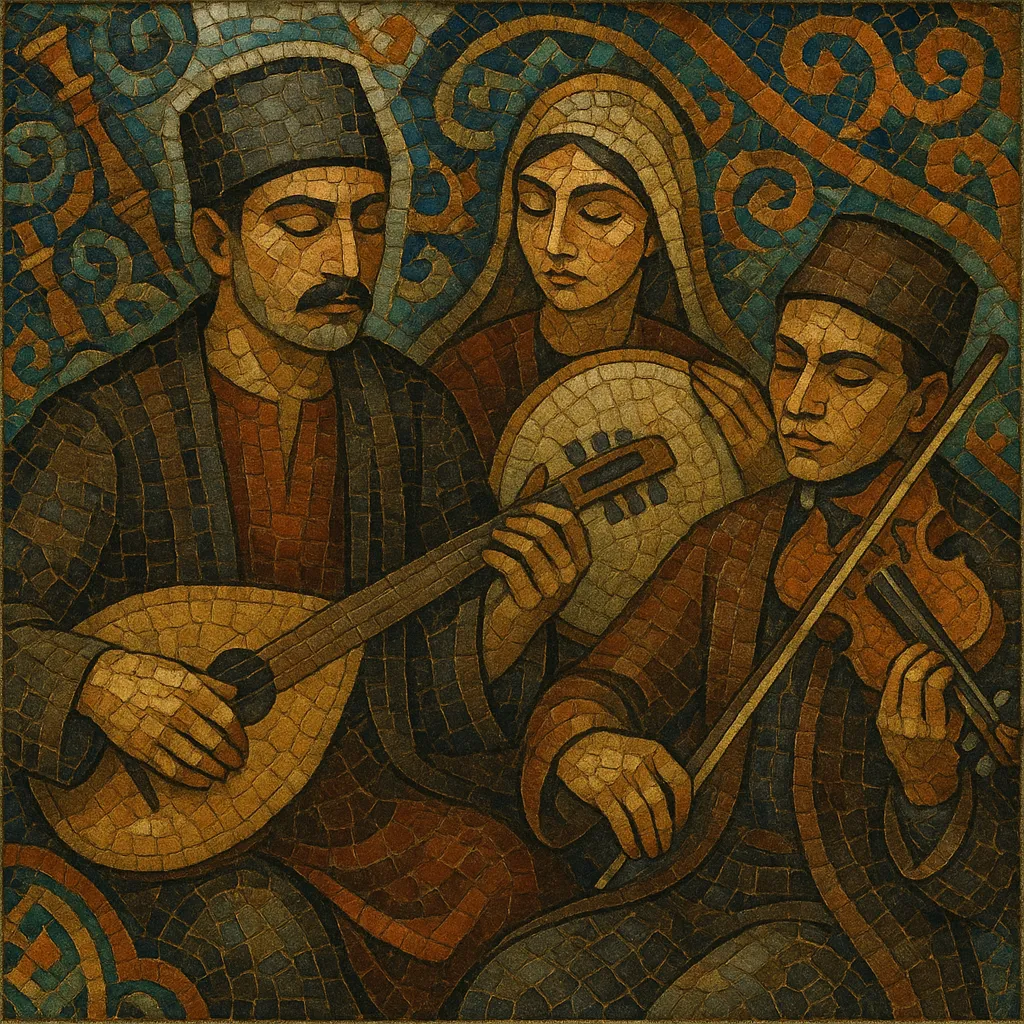
Common instruments include the saz/bağlama, violin, clarinet, zurna, accordion, and frame drum (qaval/daire), with darbuka and davul used in festive settings. Lyrics often honor love, homeland, and faith, and many modern songs memorialize the 1944 Sürgün (deportation) and the community’s return and cultural revival.
History
The crystallization of Crimean Tatar music is closely tied to the Crimean Khanate (established in 1441), when courtly and urban musics absorbed Ottoman-Turkish makam practice, while village traditions preserved older Turkic song forms. Dance types and instrumental timbres also reflect continuous contact with peoples of the Black Sea and the Caucasus.
By the 18th–19th centuries, the haytarma and other regional dance forms had become emblematic. Vocal genres ranged from narrative epics and devotional songs to lyrical uzun hava (free-meter songs). Ensembles typically performed in a heterophonic manner, with melodic embellishment shared among voice and instruments.
The 20th century brought upheaval, especially the 1944 deportation (Sürgün) that displaced the Crimean Tatars to Central Asia. Music became a vessel of memory and identity in exile, sustaining repertoire, language, and ceremony. Professional ensembles and folkloric troupes helped codify and transmit repertories, while composers and collectors documented tunes and dance variants.
With the late-1980s repatriation to Crimea, Crimean Tatar music experienced a renewed public presence. State and community ensembles revived staged dance-songs, while individual artists fused traditional idioms with jazz, pop, and contemporary folk. International recognition—most visibly through artists of Crimean Tatar heritage—has amplified the music’s global profile, even as musicians continue to safeguard language, ritual, and stylistic nuance.

%20%5BLegend%5D%2C%20Cover%20art.webp)