Your digging level

For this genre
0/8
🏆
Sign in, then listen to this genre to level up

Description

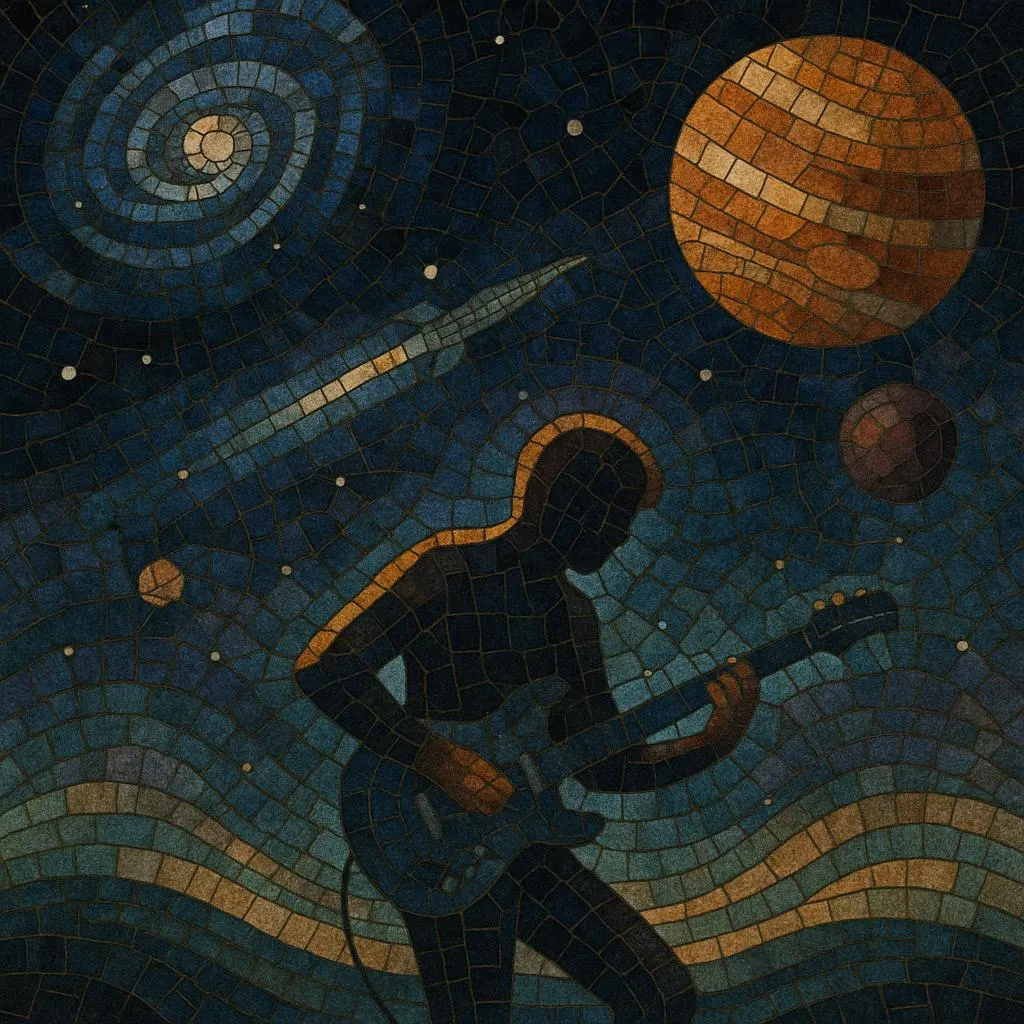
Cosmic post-rock is a spacious, largely instrumental branch of post-rock that blends shimmering, delay-soaked guitars, wide-screen synths, and patient, cinematic crescendos to evoke the scale and stillness of outer space.

The style favors long-form structures, bright “shimmer” reverbs, motorik or gently pulsing rhythms, and melodic ostinati that slowly evolve rather than verse–chorus turns. Vocals, if used at all, are textural—wordless choirs, radio chatter, or distant chants—serving atmosphere over narrative. The overall aim is an immersive, celestial soundscape that feels both contemplative and epic.


Sources: Spotify, Wikipedia, Discogs, RYM, MB, user feedback and other online sources

History

Origins (late 1990s–2000s)

Cosmic post-rock emerged as post-rock matured beyond its 1990s foundations. Artists began folding in the motorik drive and astral imagery of classic space rock with the ambient depth of modern reverb and delay processing. In the early 2000s, several European and Anglosphere bands leaned into star‑gazing themes, expansive arrangements, and luminous guitar textures, setting a template distinct from the darker or noisier post-rock strains.

Consolidation and Aesthetics (2010s)

Through the 2010s, the style coalesced around a shared vocabulary: e‑bow or bowed‑style guitars, high‑register lead lines that bloom into “shimmer” reverbs, synth pads and arpeggiators suggesting orbital motion, and steady, unhurried grooves (often in 4/4 or lilting 6/8). Artwork, song titles, and live visuals frequently referenced astronomy and deep time, reinforcing a cohesive cosmic identity.

Production and Live Expansion

Improvements in affordable pedals, amp modeling, and convolution reverbs helped bands build vast soundfields on stage and in small studios. Cinematic post-rock and ambient post-rock scenes overlapped, while film, game, and documentary placements (especially science/space media) spread the sound to wider audiences.

Present Day and Legacy

Today, cosmic post-rock is a recognized atmospheric wing of the post-rock continuum. It continues to inform cinematic post-rock, atmospheric post-rock, and space‑leaning ambient scenes, while remaining a go‑to palette for evocative, wordless storytelling about awe, isolation, and wonder.

How to make a track in this genre

Core Palette
•   Guitars (single-coils or semi-hollows) with generous delay, plate/hall/shimmer reverbs, slow attack/volume swells, and occasional e‑bow. •   Synths for pads and soft arpeggios (Juno/Prophet‑style), plus subtle sub‑bass layers. •   Bass guitar with melodic counterlines; avoid overly busy fills—support the “orbit.” •   Drums that prioritize feel and bloom: mallets, tom patterns, cymbal swells, and motorik/half‑time pulses.
Harmony & Melody
•   Favor modal centers and pedal points (Dorian, Mixolydian, Aeolian) to sustain a feeling of open space. •   Build evolving ostinati: short motifs that repeat while slowly adding notes, octaves, or harmonies. •   Use parallel planing (3rds/5ths/octaves) and high-register lead lines that dissolve into reverb tails.
Rhythm & Structure
•   Typical tempos: 60–120 BPM. Alternate between drifting halves and grounded pulses. •   Lean on long arcs: quiet intro → gradual layering → dynamic crest → spacious denouement. •   Sprinkle motorik inflections (steady 4/4 kick/hat) or lilting 6/8 to suggest forward cosmic motion.
Texture & Sound Design
•   Create “starfields” with shimmer reverbs, granular/chorus textures, and tape‑style delays. •   Introduce drones (synth or bowed guitar) to glue sections; automate filters for gentle movement. •   Tasteful ear candy: reverse swells, whooshes, filtered noise, radio snippets, or distant Morse‑like blips.
Arrangement Strategies
•   Think in layers: each instrument adds a band of the spectrum. Avoid frequency collisions. •   Reserve the full band impact for a single crest; elsewhere, let parts drop out to reveal space. •   Counterpoint over chord churn: let bass or auxiliary guitar carry alternate melodies.
Production & Mixing
•   Prioritize depth: contrasting near/dry elements against vast tails creates perceived “infinity.” •   Use high‑pass filtering to keep reverbs clear; compress reverbs subtly for bloom without washout. •   Gentle bus compression and slow attack on transient sources keep crescendos breathing.
Common Pitfalls
•   Too much wash blurs intent—maintain a dry focal line. •   Endless builds without narrative payoff—design an arc and commit to a summit and release.

Top tracks

Locked
Share your favorite track to unlock other users’ top tracks

Upcoming concerts

in this genre
Influenced by
Has influenced

Download our mobile app

Get the Melodigging app and start digging for new genres on the go
© 2026 Melodigging
Melodding was created as a tribute to Every Noise at Once, which inspired us to help curious minds keep digging into music's ever-evolving genres.
Buy me a coffee for Melodigging