Your digging level
Description
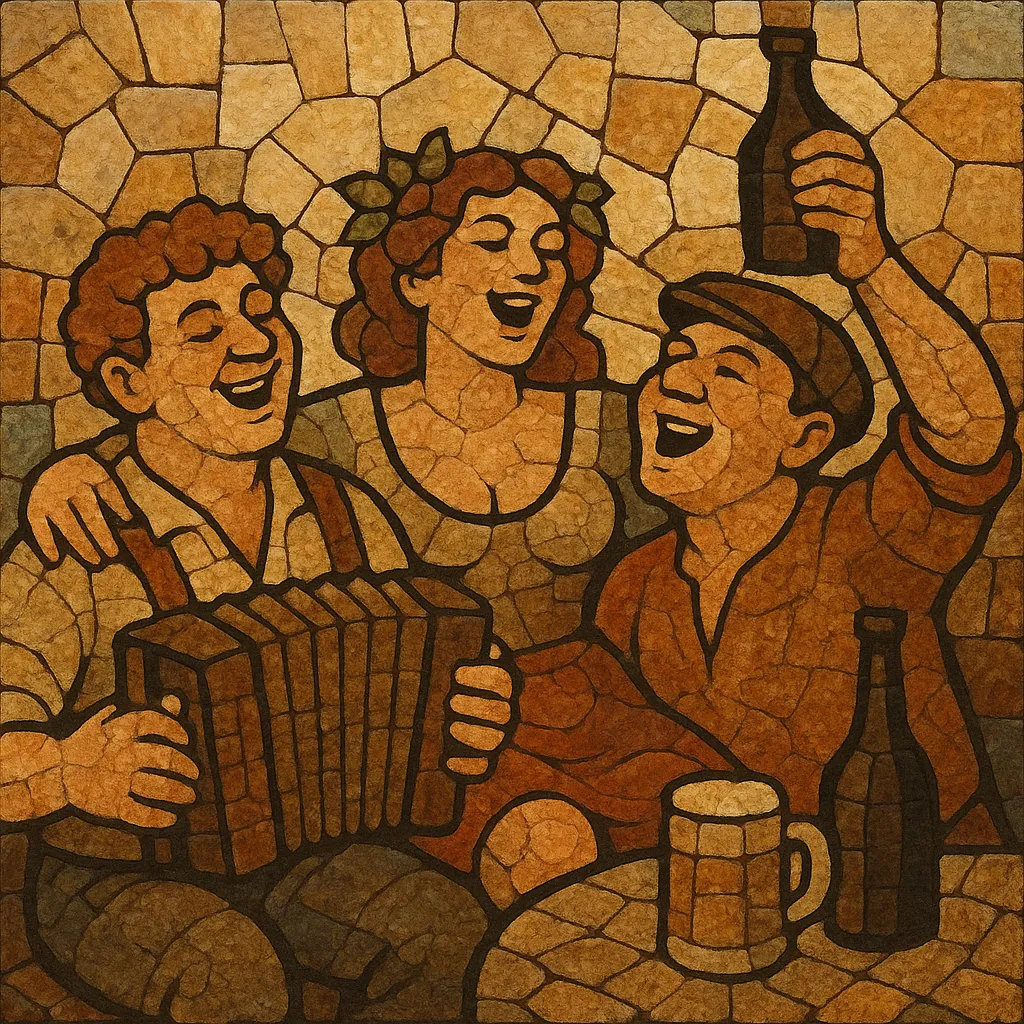
Chanson paillarde is a French tradition of bawdy, ribald, often explicitly sexual drinking songs sung in convivial contexts such as student gatherings, military messes, rugby clubs, taverns, and cabarets. Its texts rely on double entendres, earthy humor, and playful obscenity, intended more for communal laughter and camaraderie than for polite salon performance.
Musically, these songs are simple, memorable, and built for group participation: strophic melodies, repetitive refrains, and call‑and‑response structures dominate. They are frequently sung a cappella in unison or in rough parallel harmony, or accompanied by readily portable instruments like accordion and guitar. While rooted in oral tradition, many examples were later collected in printed anthologies and revived on recordings, cementing their place as a distinct, light‑hearted branch of the broader French chanson heritage.
History
The roots of chanson paillarde reach back to early modern France, when earthy, convivial songs thrived in student circles, goguettes (informal song societies), and taverns. The spirit of Rabelaisian humor—boisterous, carnivalesque, and irreverent—permeated these songs. Although some lyrics likely descend from late medieval popular song, the tradition consolidated during the 1500s–1700s as orally transmitted strophic tunes with improvised verses and bawdy refrains.
During the 19th century, goguettes in Paris and provincial cities provided spaces where comic, risqué, and topical songs circulated. Pamphlets and clandestine songbooks helped fix otherwise oral repertoire on the page. The same decades saw the rise of cabaret, where risqué material and suggestive patter overlapped with the paillarde ethos.
In the mid‑20th century, comic vocal groups and chanson interpreters recorded collections of chansons paillardes, standardizing well‑known versions and refrains. University and military cultures kept them alive as communal repertoire, while professional performers brought them to broader audiences through albums, radio, and cabaret stages.
Today, chanson paillarde endures as convivial folklore, sung in festive contexts and occasionally revived by artists interested in historical or humorous chanson. Its explicit content has prompted periodic debates about taste and decorum, but its function as shared, humorous, participatory song remains central to its identity.
Aim for convivial humor and collective participation. The lyrics should be cheeky, irreverent, and often risqué, but delivered with wit and wordplay rather than malice. Keep the musical fabric simple so non‑specialists can join in after hearing a verse or two.
Use a strophic song form with a recurring, memorable refrain. Compose a narrow‑range, diatonic melody (major mode is common) that sits comfortably in the mid‑voice for group singing. Keep phrases short and symmetrical (e.g., 4+4 bars), with clear cadences.
Choose accessible dance‑adjacent meters—2/4 or 4/4 for a march/polka feel, or 3/4 for a waltz swing. Moderate tempos suit communal chorus singing. Consider a slight lilt to encourage swaying and call‑and‑response.
Harmony should be straightforward (I–IV–V with occasional ii or vi). If accompanying, use guitar or accordion with strummed or oom‑pah patterns. A cappella unison or rough parallel thirds can be effective; encourage group shouts on cadences and refrains.
Write verses in colloquial French sprinkled with slang and double entendre. Build toward punchlines at line ends and reinforce them in the refrain. Favor internal rhyme, simple couplets, and anacrusis to propel the text. Assign a song leader to cue verses, with the crowd answering refrains and ad‑libs.
Encourage call‑and‑response, spoken asides, and communal clapping. Keep arrangements flexible so verses can be added, reordered, or improvised. Toasts and spoken interludes between verses heighten the convivial atmosphere.