Your digging level
Description
Cantonese traditional refers to the body of vernacular music from the Cantonese-speaking regions of southern China, including Guangdong and Hong Kong. It encompasses theatrical (Cantonese opera), narrative-sung genres (naamyam/naam-yam and muk’yu), ritual and folk repertoires, and the salon-style instrumental tradition often called Guangdong music.
Musically, it favors pentatonic and heptatonic modes drawn from the Chinese modal system (gong, shang, jiao, zhi, yu), heterophonic textures, and ornate melodic embellishment such as slides, mordents, and turns. Rhythm is organized around fixed “ban” (beat-frame) patterns and tempo categories (manban, zhongban, kuaiban) coordinated by a percussion leader.
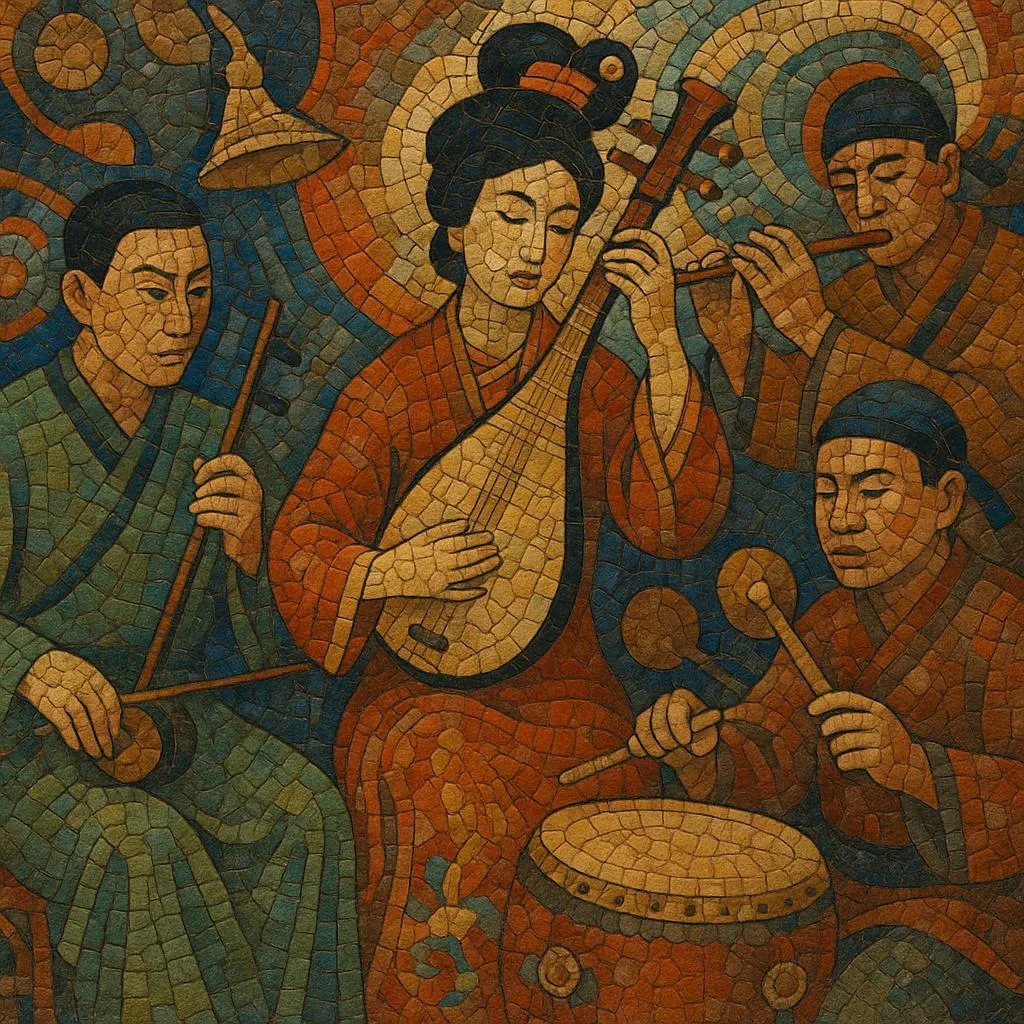
Typical ensembles are led by the gaohu (a high-pitched two-string fiddle popularized in Guangdong music) with supporting strings such as erxian/yehu and plucked qinqin/sanxian/zheng, the yangqin hammered dulcimer, dizi/ xiao flutes or suona/houguan for color, and an opera-derived percussion battery of drum, woodblock, gongs, and cymbals.
History
Cantonese traditional music coalesced in the 1800s as local opera troupes, blind narrative singers (naamyam), and ritual-folk practices adapted broader Chinese theatrical and folk idioms to the Cantonese language and regional taste. The banqiang (melodic-rhythmic) system known across Chinese opera was localized in tune-types, dialect prosody, and instrumentation.
Around the 1910s–1930s, urban salon and teahouse culture in Guangzhou and Hong Kong fostered the instrumental stream popularly labeled Guangdong music. Virtuosi such as Lü Wencheng standardized the gaohu as lead instrument, arranged opera and folk melodies for small ensemble, and notated repertory using gongche and later staff notation. Concurrently, Cantonese opera flourished on stage and in early recordings and films, establishing a canon of arias and percussion cues.
From the 1940s–1970s, radio, records, and Cantonese-language cinema amplified the reach of Cantonese opera arias, naamyam storytelling, and instrumental pieces. Migration spread the tradition to Southeast Asia and North America, where community associations sustained troupes and amateur clubs.
Today, Cantonese traditional survives in opera houses, festivals, and conservatories in Guangdong, Hong Kong, and overseas communities. Revivalists and conservatory-trained ensembles perform classic suites and reorchestrate opera melodies, while education and archival projects document naamyam and other endangered subgenres. Elements of its modal language, timbre, and declamation continue to seep into Cantonese popular music and stage works.
Use a small ensemble led by gaohu, supported by erxian or yehu, yangqin, qinqin/sanxian, and dizi or suona/houguan for color. Add an opera-style percussion section (drum, woodblock/clapper, gongs, and cymbals) to articulate form and tempo changes. Aim for heterophony: all melody instruments play the same tune with individual ornamentation.
Compose with pentatonic-based modes (gong, shang, jiao, zhi, yu) and allow passing tones to create heptatonic color. Write cantabile, arching lines with frequent slides (portamento), grace notes, turns, and appoggiaturas, especially in the gaohu. For vocal writing (opera or naamyam), match Cantonese tone contours and prosody to melodic direction and cadences.
Structure pieces within ban (beat-frame) patterns and standard tempi—manban (slow), zhongban (moderate), and kuaiban (fast). Cue transitions and climaxes through percussion breaks and formulaic drum signals. Build suites that alternate lyrical sections with livelier, percussion-driven segments, or set strophic narrative verses over a recurring accompaniment.
Keep harmony implicit; emphasize parallel ornamental lines and drones rather than Western chordal progressions. The yangqin and plucked lutes supply rhythmic-harmonic scaffolding through broken-tone patterns that outline the mode.
Use classical Chinese poetic diction mixed with vernacular Cantonese. Themes may include romance, morality tales, local histories, and heroic episodes. Ensure declamation respects lexical tones and uses melisma sparingly to retain textual clarity.

Top albums