Your digging level
Description
Čalgija (also spelled Chalgiya/Chalgija) is an urban folk idiom of the southern Balkans that crystallized in the 19th century within the Ottoman cultural sphere. The term comes from Turkish “çalgı” (instrument/music-making) and denotes refined, café- and salon-based repertoires sung and played by small ensembles.
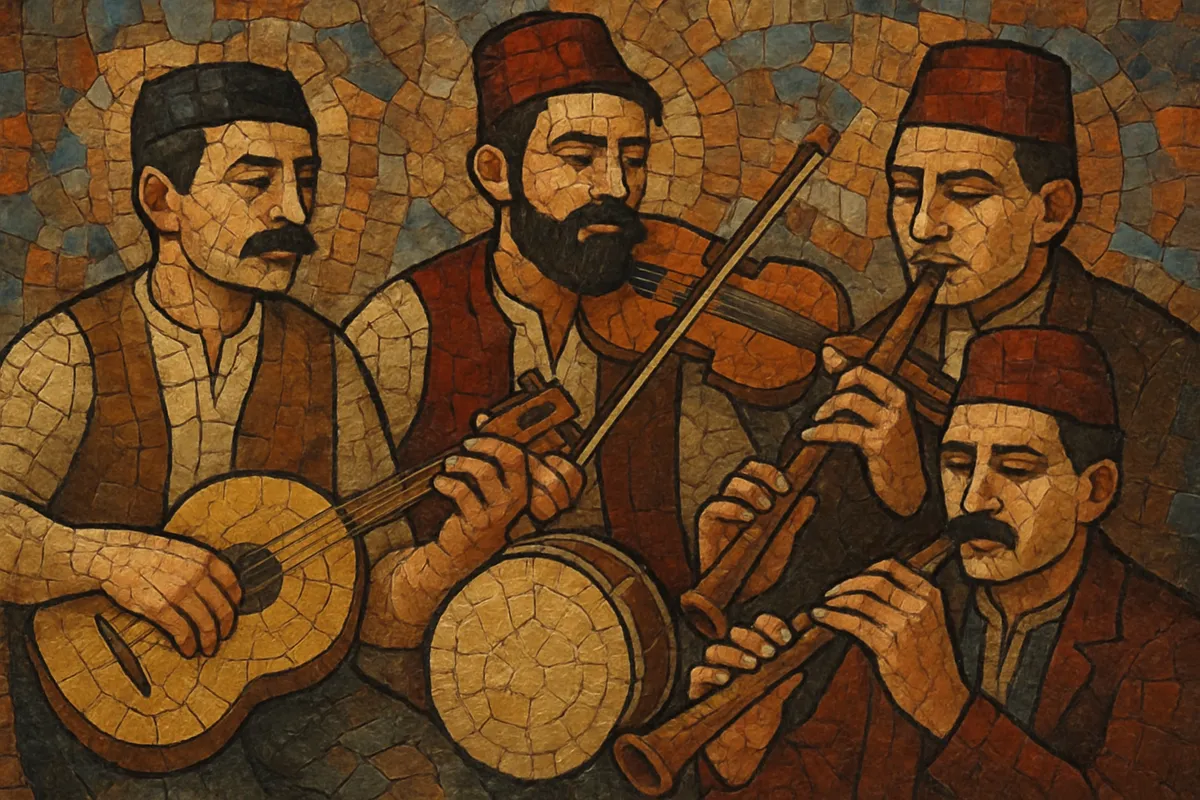
It is modal (makam-based), richly ornamented, and commonly set to asymmetric “aksak” rhythms (e.g., 7/8, 9/8, 11/8). Typical instruments include oud, tambura, violin, clarinet, qanun, and hand percussion such as darbuka and frame drum; occasional kaval, ney, or tapan appear regionally. Vocals favor melisma and rubato preludes (taksim) and carry urban themes of love, longing, and everyday life.
As both a Bulgarian urban-traditional subgenre and a Macedonian urban folk practice performed by ensembles called “Čalgii,” it bridges Ottoman classical taste with local Slavic, Greek, and Romani traditions, producing a cosmopolitan, nostalgic sound world.
History
Čalgija arose in the 1800s across Ottoman Balkan towns (Skopje, Bitola/Monastir, Ohrid, Veles, and urban centers in today’s Bulgaria). Its name derives from Turkish “çalgı,” reflecting early roots in Ottoman court/urban classical practice (makam, taksim, stylized dance rhythms) as filtered through local café culture and Romani professional musicians. Modal systems (Rast, Hijaz, Nihavent/Nikriz, etc.) and asymmetric meters were fused with South Slavic poetry and regional urban song.
In Macedonia, small groups known as “Čalgii” popularized the genre, accompanying singers in salons, meyhanes (taverns), and festive events. The ensemble core—oud/tambura, violin, clarinet, qanun, and darbuka—standardized a sound that balanced intimate ornamented vocals with instrumental preludes (taksim) and instrumental dances. In Bulgaria, chalgiya became a distinguished strand of old-town (stara gradska) urban tradition, parallel to Macedonian practice but sharing the same Ottoman cosmopolitanism.
Commercial recordings, radio, and state ensembles helped circulate urban songs. Repertoires overlapped with neighboring Smyrnaic/Asia Minor, Greek, and Romani traditions; musicians often worked across styles (oro dance music, sevdah-inflected songs, and café repertoires). Despite shifts brought by modern nation-building and folklorization, core čalgija aesthetics—modal improvisation, melisma, and aksak grooves—remained intact in local scenes and archives.
From the late 20th century, čalgija was preserved by dedicated Macedonian “Čalgii” groups and Bulgarian urban-traditional performers, while scholars and revivalists documented repertoires. Although sometimes confused with contemporary Bulgarian “chalga” (a pop-folk genre), čalgija is historically distinct: it is the earlier urban, acoustic, makam-based tradition whose ethos and practices nonetheless informed later pop-folk and laïko-adjacent styles. Today, it endures in concert settings, festivals, conservatories, and recordings focused on urban heritage and Ottoman-era musical memory.