

Your digging level
Description
Ca Huế is a refined chamber tradition from the central Vietnamese city of Huế, associated with the courts and scholar-gentry of the Nguyễn lords and later Nguyễn dynasty. It is widely regarded as a classical Vietnamese genre that blends courtly aesthetics with local folk poetics from the ancient land of Thuận Hóa (today’s Huế).
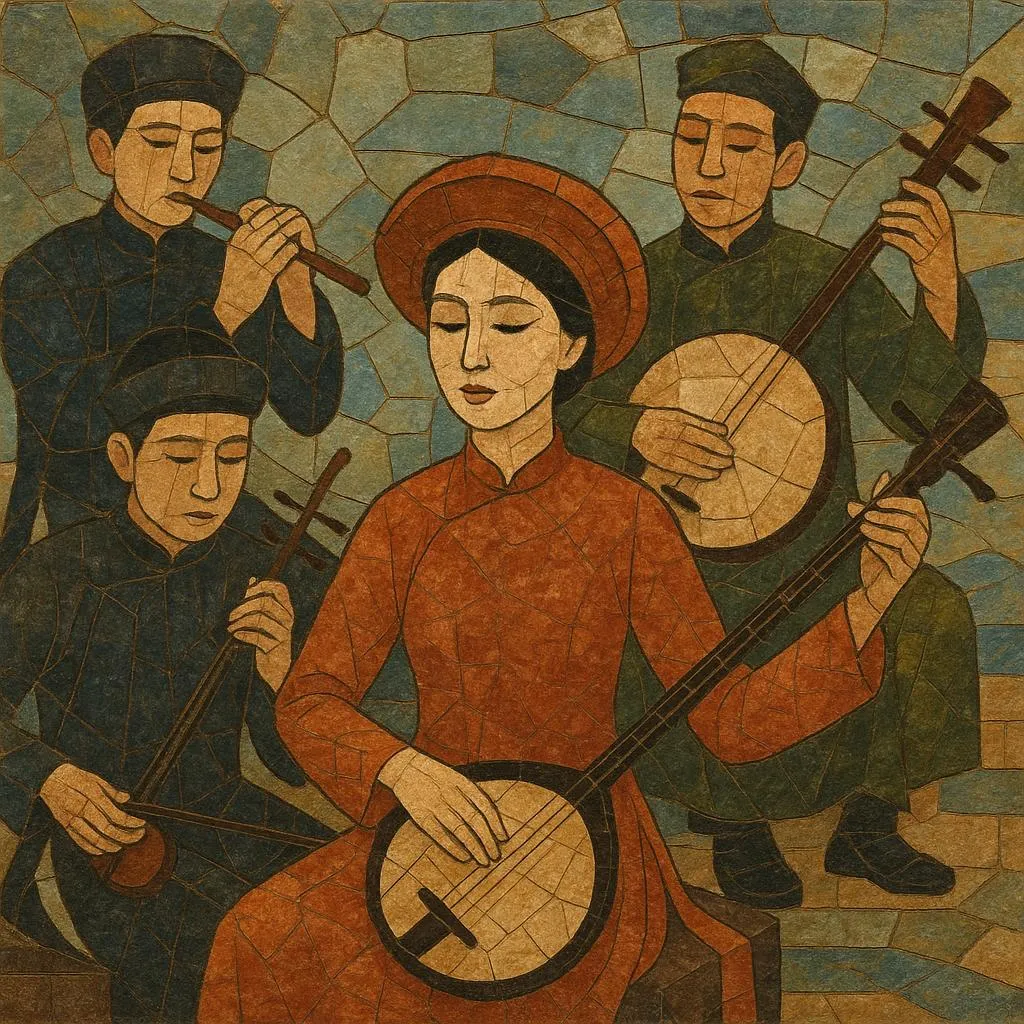
Performed by a small ensemble accompanying a highly ornamented voice, Ca Huế emphasizes timbral nuance, flexible rhythm, and elegant poetic delivery. Typical instruments include đàn tranh (16-string zither), đàn nguyệt (moon lute), đàn tỳ bà (pear-shaped lute), đàn nhị (two-string fiddle), đàn bầu (monochord), sáo trúc (bamboo flute), and light percussion. The vocal repertoire pivots around two principal modal-affective spheres—hơi Bắc (brighter, more decorous) and hơi Nam (darker, more plaintive)—with canonical pieces such as Nam bình (serene, stately) and Nam ai (deeply melancholic). The poetry commonly uses lục bát and song thất lục bát meters, and delivery favors microtonal slides, mordents, and delicate vibrato.
Historically presented in intimate salons and on the Perfume River in evening boat concerts, Ca Huế remains a living heritage emblematic of Huế’s courtly culture and contemplative atmosphere.
History
Ca Huế is believed to have taken shape under the Nguyễn lords in the 1600s, when Huế (then Thuận Hóa/Phú Xuân) rose as a political and cultural center. Courtly taste, literati salons, and local folk traditions converged to produce a cultivated song genre distinct from northern traditions such as ca trù while remaining dialogic with imperial court repertories.
Under the Nguyễn dynasty, Ca Huế matured as a chamber idiom alongside court ceremonial music. A small ensemble supported an ornamented vocal line, codifying modal-affective categories (notably hơi Bắc and hơi Nam). Canonical pieces—like Nam bình (restrained lyricism) and Nam ai (profound lament)—crystallized as emblematic pillars of the tradition. Poetic texts in lục bát and song thất lục bát meters anchored performances in Vietnam’s classical verse culture.
Beyond palatial spaces, Ca Huế migrated to Huế’s riverboats and scholar households, becoming a hallmark of the city’s nocturnal and contemplative soundscape on the Perfume River. Musicians sustained lineages of technique and repertory through oral transmission, while instrument building and performance practice adapted to modern contexts without losing core aesthetics.
Today, Ca Huế is preserved by conservatories, heritage ensembles, and community clubs in Thừa Thiên–Huế, and is performed both in formal concerts and on river cruises. While closely related to imperial court traditions (nhã nhạc) and central folk poetry, it has also informed later southern chamber and theater genres. Preservation efforts focus on pedagogy, authentic instrumentation, modal knowledge, and poetic diction, ensuring the continuity of this emblematic classical tradition of Huế.
Work within the two principal modal-affective spheres:
•Hơi Bắc: brighter, decorous color; suitable for measured, stately pieces (e.g., Nam bình aesthetics).
•Hơi Nam: darker, plaintive color; suited to lament-like expression (e.g., Nam ai aesthetics).
•Set texts in classical Vietnamese verse (lục bát; song thất lục bát). Align musical cadences to poetic caesuras and rhyme.

