

Your digging level
Description
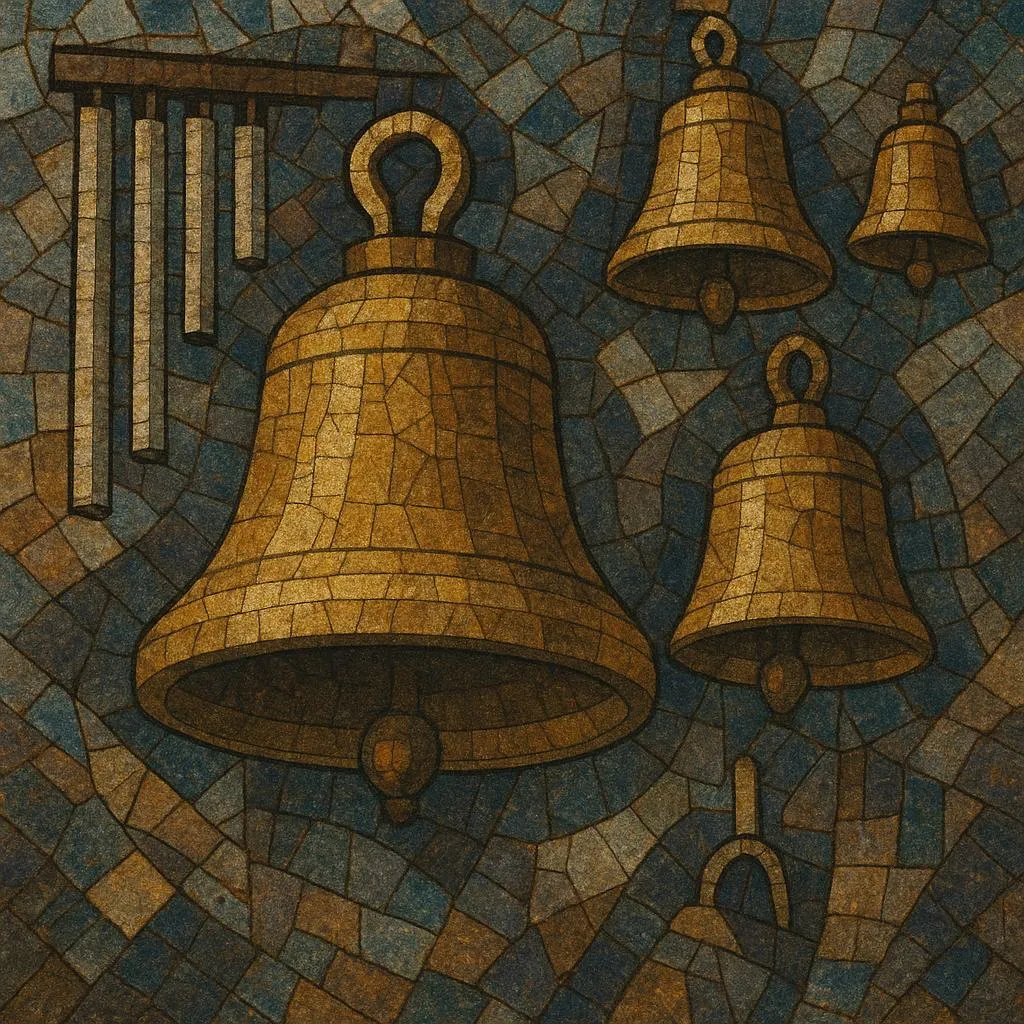
Bells is a genre centered on music performed on bell instruments—most prominently the tower carillon, change-ringing peals, handbell choirs, and concert chimes/tubular bells.
Its sound world is defined by long, shimmering decays and inharmonic overtones that create a luminous but sometimes austere resonance. Melodies tend to be clear and diatonic so they can project through the rich ring and after-sound of each bell, while harmony is voiced widely to avoid muddying the spectrum. Historically tied to liturgy and civic ceremony, the genre today ranges from solemn tolls and processional fanfares to complex keyboard-like carillon repertoire and virtuosic handbell arrangements, as well as ambient and seasonal recordings that foreground the instrument’s unique timbre.
History
Bells entered European sacred and civic life in the early Middle Ages, where simple tolls and patterns signaled liturgical hours and public events. By the Renaissance, foundries in the Low Countries perfected large bronze bells, laying the groundwork for coordinated bell music rather than mere signaling.
In the 1600s the Low Countries (present-day Belgium and the Netherlands) developed the carillon—keyboard- and pedal-controlled sets of tuned bells in a tower. This transformed bell ringing into a true performance medium and catalyzed a dedicated repertoire and pedagogy. The instrument’s idiom emphasized cantabile melodies, wide voicings, and rhythmic clarity against long decays.
In England, change ringing evolved as a mathematical and athletic art of permutations on sets of bells swung full-circle, influencing compositional thinking about sequences and patterns. Smaller handbells later migrated into parlors and, by the 19th century, into ensemble contexts, setting the stage for modern handbell choirs.
Figures such as Jef Denyn professionalized carillon performance and education (e.g., the Mechelen Carillon School). Urban towers commissioned new instruments and pieces, while American universities and civic centers adopted the carillon tradition. Handbell choirs proliferated in North America and the UK, building extensive arrangements from hymn-tunes to contemporary music.
Today, "bells" spans concert carillon recitals, English change-ringing traditions, advanced handbell ensembles, and studio work that uses tubular bells and sampled carillons in film, ambient, and seasonal music. Composers exploit the instrument’s inharmonic spectra, spatial projection, and ceremonial associations, bridging early techniques with modern minimalism and sound design.






