Your digging level
Description
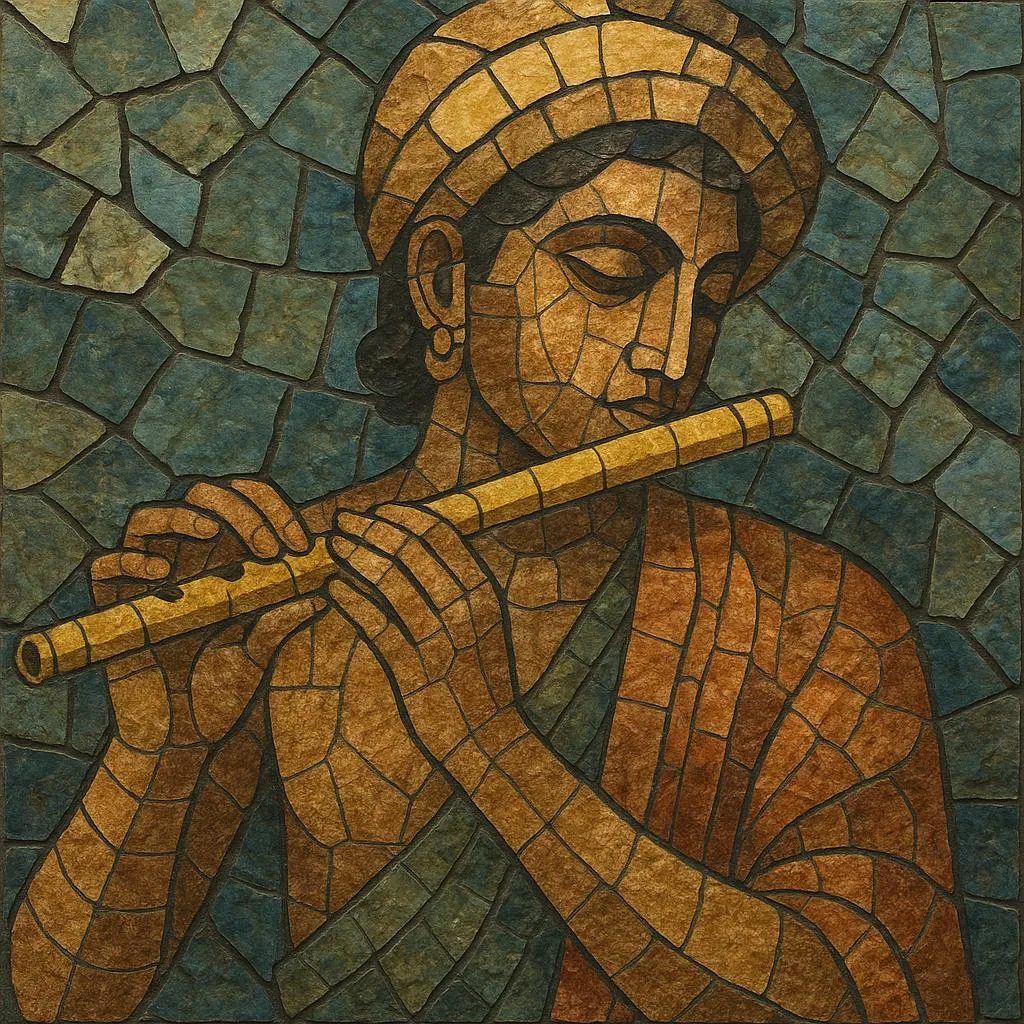
Bansuri refers to the North Indian bamboo transverse flute and, by extension in music tagging, the Hindustani classical and folk repertoire centered on this instrument.
Carved from a single length of thin-walled bamboo with six or seven finger holes and a side-blown embouchure, the bansuri is emblematic in Indian art and mythology (notably the flute of Krishna) and appears in temple sculpture and texts from the early centuries CE. In the 20th century it evolved from a primarily pastoral/folk voice into a fully fledged concert instrument for raga performance.
History
Depictions of transverse flutes associated with Krishna appear in early Hindu, Buddhist, and Jain art, while classical treatises such as the Natya Shastra discuss the venu/vamshi family of flutes. These sources place the instrument’s presence in the Indian subcontinent well before the common era and into the first centuries CE.
For centuries the bansuri was most often a pastoral or light-classical accompanist. In the 20th century, Pannalal Ghosh expanded the instrument’s length, bore, and technique (including a seven-hole design and larger bass flutes), establishing the bansuri as a principal vehicle for full-scale Hindustani raga performance on concert stages and radio.
From the late 1960s onward, exponents such as Hariprasad Chaurasia brought the bansuri to worldwide audiences through rigorous khayal-style alap–jor–jhala elaboration, collaborations, film scoring, and pedagogy, inspiring subsequent generations (e.g., Rakesh Chaurasia, Ronu Majumdar) and cementing the instrument’s modern classical status.
Bansuri performance thrives across classical sabhas, film/television studios, and global fusion contexts, where its timbre adapts readily to jazz, ambient, and electronic textures while retaining raga grammar.