Your digging level
Description
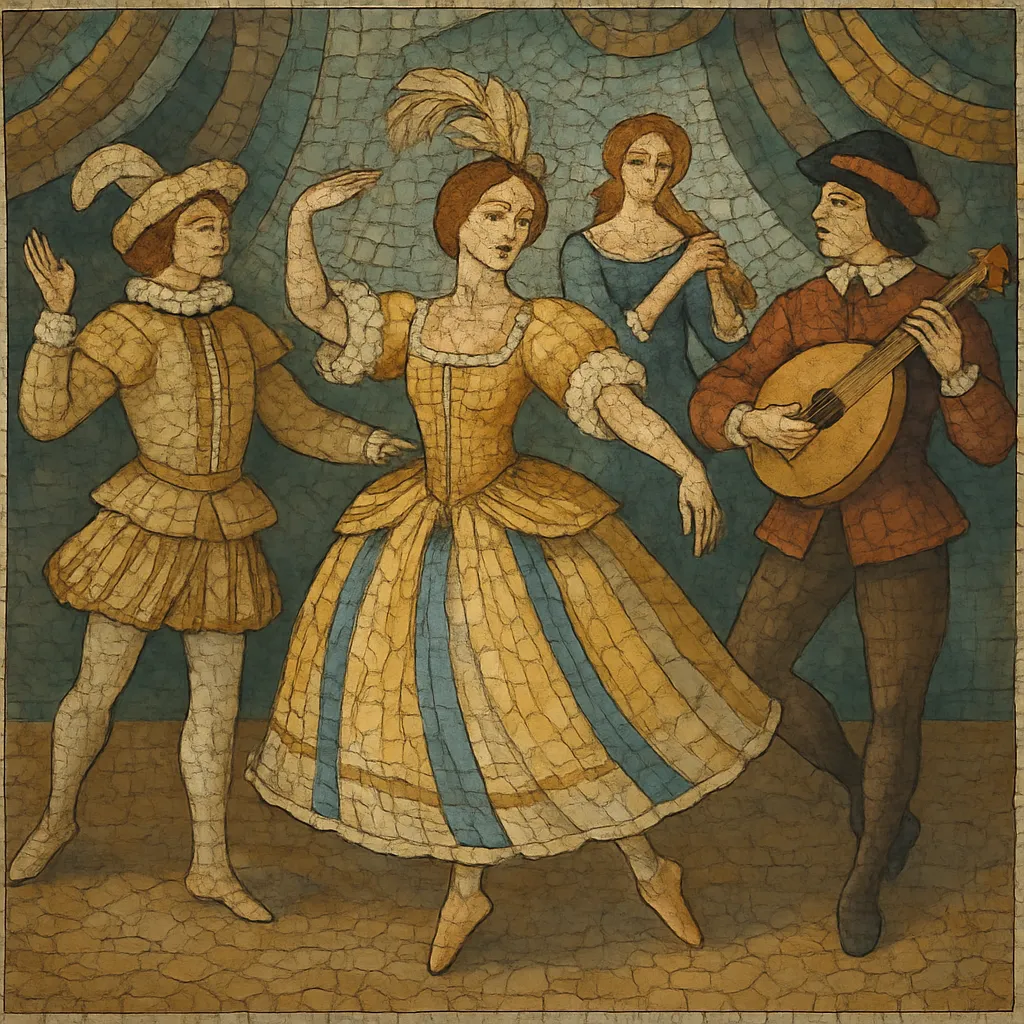
Ballet de cour (court ballet) was a lavish French courtly entertainment that fused dance, vocal and instrumental music, spoken allegory, poetry, and spectacular stagecraft. Emerging in the late Renaissance and flourishing into the early Baroque, it was performed by a mixture of professional musicians and noble amateurs in large ceremonial halls, tennis courts, or improvised theaters at court.
Its dramaturgy revolved around sequences of contrasting entrées (self-contained numbers) unified by mythological or allegorical themes that celebrated dynastic power, diplomacy, and ideals of order and harmony. The musical language bridged modal Renaissance practices and early tonal tendencies, drawing on popular and court dance types (branles, pavanes, galliards, courantes) and on courtly song traditions such as the air de cour.
History
The ballet de cour crystallized in France in the 1580s, with the often-cited milestone of Balthazar de Beaujoyeulx’s Ballet Comique de la Reine (1581). These spectacles grew from a nexus of Renaissance pageantry, French court dances, and courtly song traditions, while also absorbing elements akin to Italian intermedi. They mixed dance, chorus, solo song, and spoken allegory into a unified ceremonial narrative that promoted royal authority and aristocratic ideals.
Under Henry IV and especially Louis XIII, the genre matured: composers such as Pierre Guédron, Jacques Mauduit, and Antoine Boësset supplied airs de cour, choruses, and dance music for sequences of entrées featuring nobles and professionals together. Louis XIII himself participated as dancer and composer (e.g., Ballet de la Merlaison). Production values expanded with intricate costumes, machinery, and geometric floor patterns, while the music straddled late Renaissance modality and emergent tonality.
In the 1650s, the young Louis XIV danced prominent roles (famously as the Sun in the Ballet de la Nuit, 1653). Collaborators like Jean de Cambefort, Michel Lambert, and the rising Jean-Baptiste Lully heightened musical cohesion and rhythmic vitality. As Lully centralized royal musical institutions, court ballet aesthetics flowed into new hybrid forms: the comédie-ballet (with Molière) and the tragédie en musique. By the later 17th century, the autonomous ballet de cour yielded to opera and opéra-ballet, though its conventions of entrée-based structuring, dance integration, and allegorical flattery remained foundational.
Ballet de cour bequeathed to European stage art a codified relationship between dance and drama, the entrée sequence format, and the fusion of spectacle with political symbolism. It underpinned the development of ballet as an independent art, the French operatic tradition (tragédie en musique), and later opéra-ballet, setting a template for courtly representation on stage.
Use a mixed early–Baroque court ensemble: viols and early violins; recorders, transverse flutes, and oboes (hautbois); bassoon; cornetts and sackbuts where appropriate; lutes/theorbo and harp; and a continuo group (harpsichord/organ with theorbo). Light percussion (tabor, small drum) can support processional or martial moments.
Structure numbers around recognizable dance meters and tempi: pavanes (duple, stately), galliards (lively triple with characteristic hop), branles (processional or chain dances in duple), and courantes (flowing triple). Keep phrases symmetrical and cadence points clear to support choreography and geometric floor patterns.
Favor clear, diatonic textures that pivot between late modal colors and emerging tonal centers. Employ simple triadic harmony, cadential formulas, and parallel homophony for choruses. Melodies should be singable, with courtly elegance and clear declamation for airs de cour; use imitation sparingly to retain dance clarity.
Organize the spectacle as a sequence of contrasting entrées (masque-like episodes) unified by an allegorical or mythological theme praising the monarch or state. Alternate dance-only numbers, solo airs, choruses, and tableaux. Include grand processions for openings and a festive grand ballet for the conclusion.
Texts (if any) should be allegorical, celebrating order, virtue, and royal power through mythic figures and pastoral personae. Refrains and choruses can reinforce mottos and courtly ideals. Coordinate costume, emblem, and staging with the music to communicate political symbolism.
Write music to highlight entrances, formations, and character contrasts. Mark tempi and groove unambiguously for dancers; leave space for révérences and formal bows. Consider antiphonal placement of singers/instruments for spatial effects in large halls.

Top albums