Your digging level
Description
Achomi music is the traditional and contemporary music of the Achomi (Larestani/Ajami) people from southern Iran, especially the towns of Lar, Evaz, Gerash, Bastak, and Bandar Lengeh, with long-standing diasporic ties across the Persian Gulf (Bahrain, Kuwait, Qatar, the UAE, and Oman).
It blends Persian modal aesthetics with coastal Bandari grooves and Gulf rhythmic sensibilities. Songs are commonly performed at weddings and community gatherings, featuring driving 6/8 rhythms, call-and-response refrains, and melismatic vocals. Lyrics are sung in the Achomi (Larestani) language—often alongside Persian—and incorporate Arabic loanwords due to maritime trade and migration.
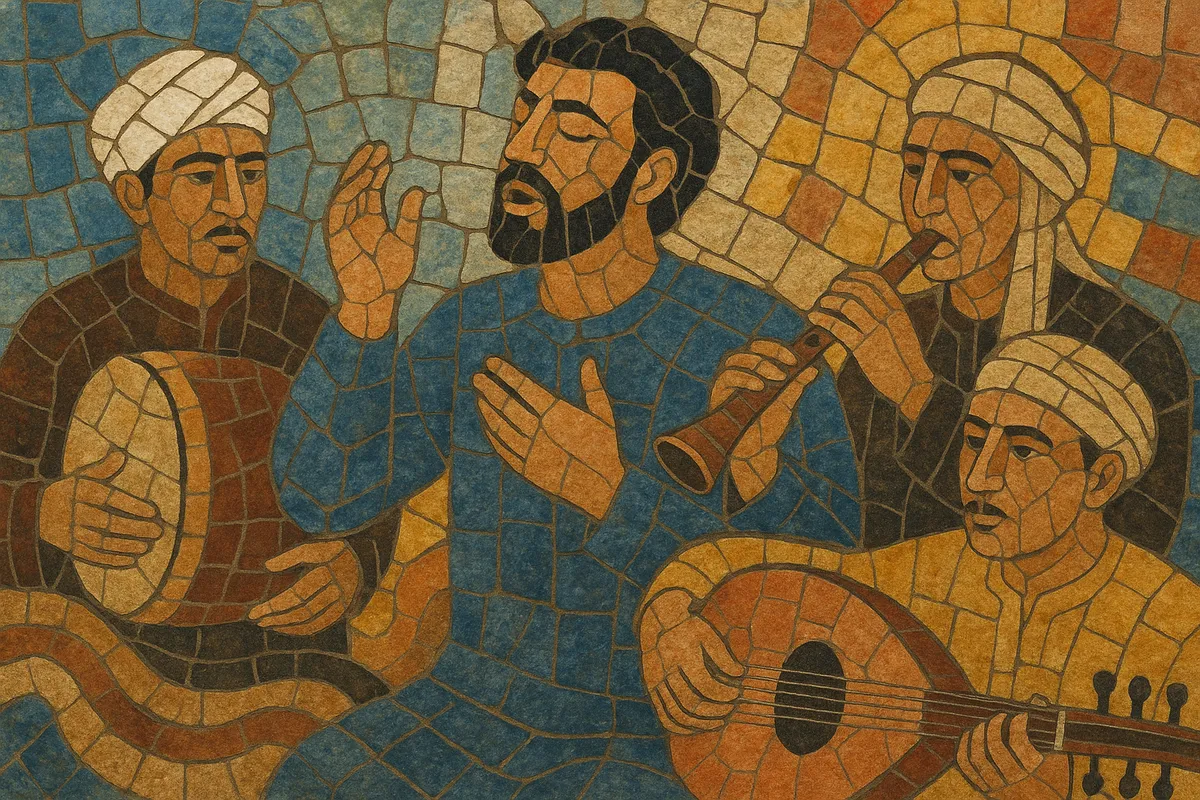
Typical instruments include dohol (bass drum), dayereh/daff (frame drum), tonbak (goblet drum), sorna or ney-jofti (double-reed), the coastal Iranian bagpipe ney-anbān, and, in modern settings, oud, violin, keyboard, and programmed percussion. Contemporary Achomi pop arrangements retain the dance-forward pulse while introducing accessible melodies and simple harmonies for festive settings.
History
Achomi music arises from the Larestani/Achomi communities of southern Iran (Fars and Hormozgan provinces). For centuries, Achomi people engaged in trade and seafaring across the Persian Gulf, which shaped their musical vocabulary through continuous exchange with Gulf Arab ports.
The style retains a Persian modal backbone (dastgāh/dastān traditions) while adopting coastal rhythms akin to Bandari and Gulf folk dances. Instruments such as dohol, daff, sorna, and ney-anbān anchor celebratory contexts (weddings, circumambulations, and community festivities), while poetic texts and melismatic singing reflect broader Persianate aesthetics.
From the early to mid‑1900s, Achomi migration to Bahrain, Kuwait, Qatar, the UAE, and Oman intensified. This mobility fostered reciprocal influence between Achomi repertoire and Gulf forms, especially community dance music and urban entertainment circuits. Achomi performers contributed to the region’s lively wedding band culture and interacted with sawt and emerging urban Gulf song traditions.
By the late 20th and early 21st centuries, Achomi music incorporated keyboards, drum machines, and studio production, yielding a dance‑pop aesthetic that kept the hallmark 6/8 swing and call‑and‑response choruses. Today, recordings circulate through community media, weddings, and social platforms, while the music continues to act as a cultural anchor for Achomi identity on both sides of the Gulf.

Top albums
%2C%20Cover%20art.webp)


%20%D8%B3%DB%8C%D8%A7%D9%87%20%D8%B2%D9%86%DA%AF%DB%8C%20(Traditional%20Bandari%20Music%2C%20Volume%201%3A%20Siah%20zangi)%2C%20Cover%20art.webp)